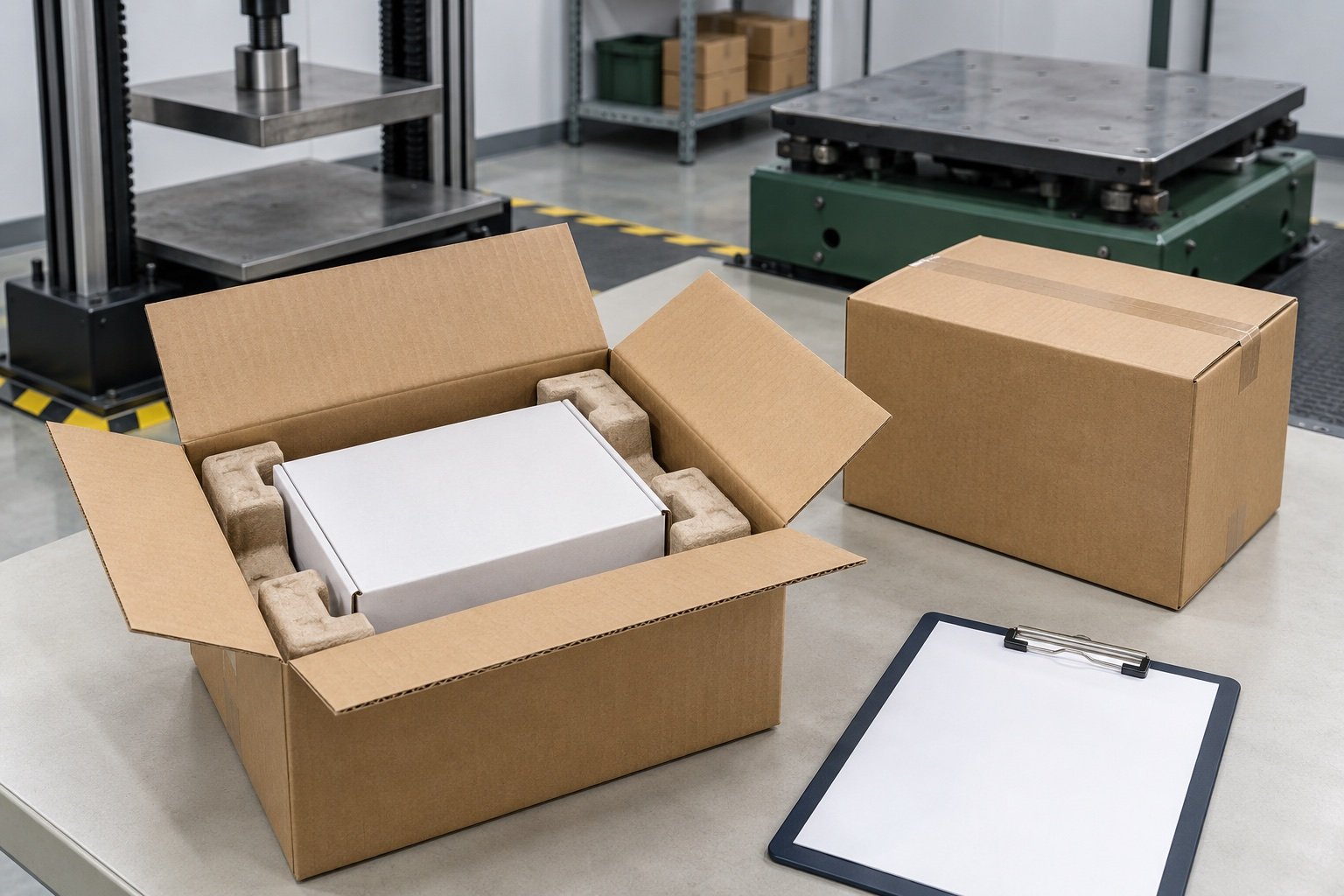
Direct answer: A packaging transit test brief should define the product, retail pack, shipping carton, pack-out, distribution route, handling risks, conditioning, test sequence and acceptance criteria. Buyers should test a production-representative configuration and record what the result does and does not prove.
Start with the product risk
Record product dimensions, weight, fragility, sharp or protruding areas, surface sensitivity, liquid or powder content and orientation limits. Identify which damage is commercially critical: breakage, cosmetic scuffing, seal failure, deformation, leakage, loss of presentation or another agreed condition.
The packaging cannot be evaluated independently from the product. Use actual products or documented substitutes whose mass, geometry and vulnerable areas are representative.
Define the complete pack-out
| Layer | Information to lock |
|---|---|
| Primary or retail pack | Structure, insert, closure, material and product orientation |
| Inner protection | Wrap, sleeve, divider, void fill and accessory position |
| Shipping carton | Dimensions, board construction, count, sealing and gross mass |
| Pallet or parcel configuration | Stack pattern, stretch wrap, corner protection or parcel assumptions |
| Environmental condition | Relevant temperature, humidity, storage and conditioning brief |
Translate the shipping route into hazards
Describe parcel, pallet, ocean, air, courier or mixed distribution and the expected handling points. Qualified packaging personnel can then select an applicable sequence for compression, vibration, impact, drop or environmental conditioning. Do not choose a standard only because a competitor names it; method, level and sequence should fit the distribution system and product risk.
Write objective acceptance criteria
Define how product function, appearance, pack integrity, closure, insert retention and shipping-carton condition will be judged after testing. State measurement points, allowable cosmetic change and who decides disposition. “No damage” is too vague when minor carton marks may be acceptable but product scuffing is not.
Control the tested configuration and changes
Record dieline revision, materials, insert, product load, carton, sealing, quantity, conditioning, test method, laboratory or test location, date and observations. Photograph pre-test and post-test conditions. If product weight, pack-out, board, insert, carton count or route changes, review whether the earlier result remains applicable.
Frequently Asked Questions
Is a drop test enough to approve packaging?
Not always. The distribution route may also create compression, vibration, environmental or repeated-handling risks.
Can an empty box be transit tested?
It can support structural learning, but final approval normally needs a representative product and complete pack-out.
Who should select the test method?
Use qualified packaging personnel or a suitable laboratory that understands the product and distribution route.
What is a production-representative sample?
Its product load, materials, structure, insert, carton and assembly route match or clearly document differences from production.
When should testing be repeated?
Review changes to product, weight, orientation, materials, insert, carton count, sealing, pallet pattern or distribution route.
Prepare a Project-Specific Transit Test Brief
Send the product, packed weight, proposed structure, shipping carton and distribution route. MSQ PACK can organize the open questions for qualified test planning.